5 min read
We Asked ChatGPT to Write Our Core Behaviors. Here's What Happened.
Tyler Howard
:
September 22, 2026
A CEO we talked to did the sensible thing. He had a handful of company values, he wanted the behaviors underneath them, and he had a tool that writes for a living. So he opened ChatGPT, pasted in his values, and typed something like "extrapolate some behaviors out of this."
It worked. Ten seconds later he had a list.
Then he read it. His words: "It was a lot of like blank and blank and blank." Communicate openly and honestly. Treat others with respect. Take ownership of your work. Clean, reasonable, and completely interchangeable with the list of any other company on earth. He had asked a machine that has read the entire internet to describe his culture, and it handed him the average of everyone's.
That is the whole problem with letting AI write your core behaviors. It is fast, it is fluent, and it changes nobody's Tuesday.
The short version
- AI can write a list of core values in seconds. It cannot write yours. It writes the average of every values page it has ever seen, which is why the output reads as generic.
- Generic behaviors do not change how anyone works, because nobody can see themselves in them. "Treat others with respect" is not something you can watch for, coach, or hold a person to.
- Real core behaviors come from inside the company, from how your best people already operate, defined by the leaders who run it. That is the part a prompt cannot do for you.
- The right way to write core values is to translate them into specific, observable behaviors, then practice those behaviors on a rhythm until they stick. CultureWise runs that as Culture by Design.
- AI is a fine editor once you have done the human work. It is a terrible substitute for it.
Can ChatGPT write your company's core values?
It can write a set of core values. It cannot write the set that describes your company. AI generates language by averaging everything it has read, so what comes back is a competent, plausible, forgettable list that would fit any company in any industry.
That is not a flaw in the prompt. It is the nature of the tool. Ask a model trained on a million values pages what your values should be, and it returns the center of that million. Your company is not the center of a million. It is a specific place with specific people who do specific things well, and none of that lives in the training data.
So the shortcut feels like progress. You have a document. But a document is not the thing you needed.
Why do AI-generated core behaviors feel so generic?
Because they are describing no one. "A lot of blank and blank and blank" is exactly right: the words are real, but they are unowned. They came from everywhere, so they belong to nobody, so nobody in your building reads them and thinks "that's us."
Compare two versions of the same idea. AI gives you "Communicate openly and honestly." A behavior that came from your own team sounds more like: "Say the hard thing. If something's wrong, name it in the room, not in the parking lot afterward." One is a poster. The other is a rule you could hold a manager to on a Tuesday afternoon.
The difference is not polish. It is specificity, and specificity only comes from knowing the company. A model does not know that your best project manager quietly re-checks every handoff, or that your culture lives or dies on how people deliver bad news to a client. Your leaders know that. The behavior worth defining is the one your people already recognize.
What's the difference between a list of behaviors and behaviors that change how people work?
Ownership. A list is words on a page. Behaviors that change how people work are recognizable, specific, and defined by the people who have to live them, which is why they carry weight the list never does.
Watch what happens in the room. When leaders write their own behaviors, they argue. They tell stories. Somebody says "that's not how we operate, here's what we do instead," and the language gets sharper. That friction is the point. It is how a vague value becomes a behavior specific enough to coach. You cannot outsource the argument to a chatbot, because the argument is where the culture gets named.
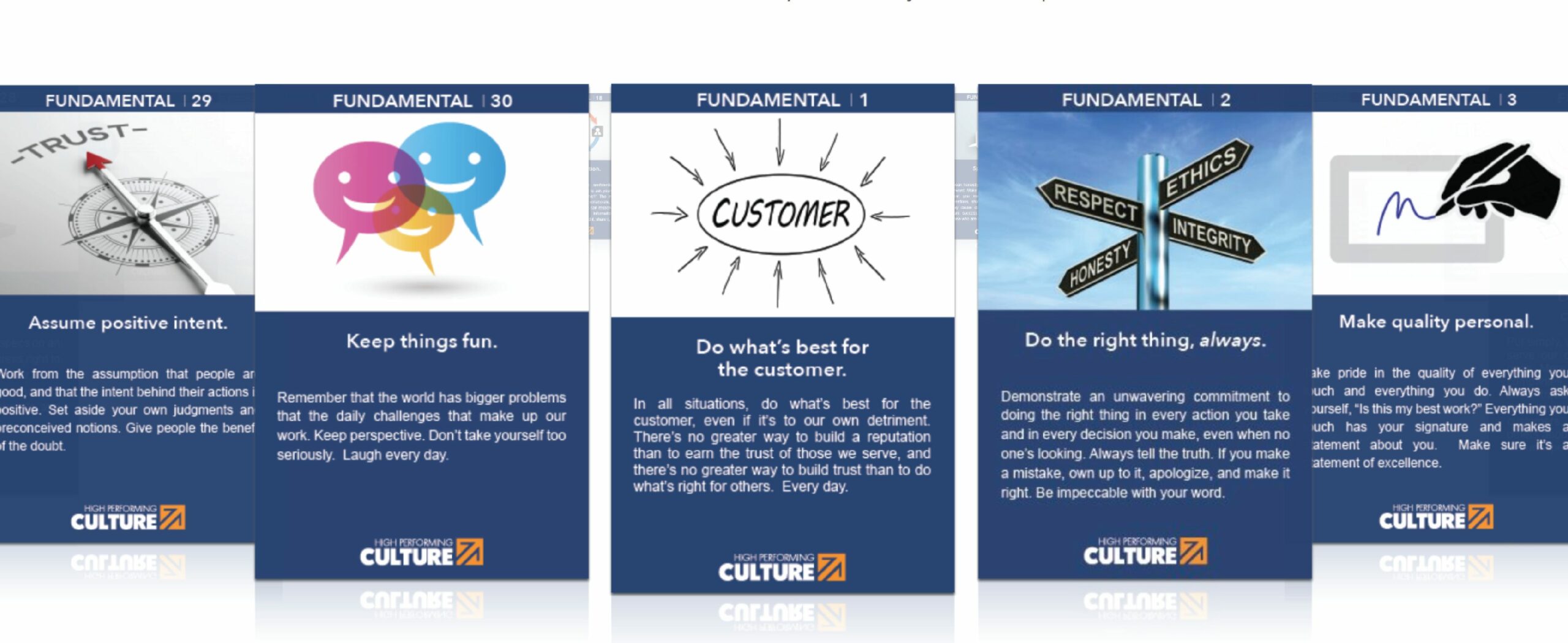
One company's leadership team went through exactly this. CultureWise helped each leader identify the behaviors they believed mattered most, and through discussion they shaped them into 31 core behaviors of their own. Not a downloaded list. Thirty-one behaviors the leaders could defend, because they wrote them.
Where do real core behaviors come from?
From inside the company, not from a prompt. The best behaviors are usually already happening. They are the way your strongest people work when nobody is watching, and the job is to notice them, name them, and make them the standard for everyone.
That is why the source matters more than the wording. A behavior lifted from the internet has no evidence behind it. A behavior pulled from how your team already operates comes with a hundred real examples people have seen with their own eyes. The first one asks people to believe a poster. The second one asks people to keep doing what the best among them already do, on purpose, every day.
This is the difference between values and behaviors, and it is the single most common thing buyers tell CultureWise: we have the values, we do not have the specific behaviors that deliver them. The values were never the hard part. Turning them into observable actions your people recognize is.
How should you write core values that change behavior?
Start from your company, not from a blank prompt. Translate each value into the specific, observable behaviors that deliver it in your business, led by the people who run the company, then practice those behaviors on a rhythm until they become habit.
Use this sequence:
1. Define the behaviors that drive success in your company. Look at how your best people operate and put words on it. Specific enough that someone could watch for it.
2. Make each one observable. If you cannot picture a person doing it, rewrite it. "Respect" is a value. "Do what you say you're going to do, when you say you'll do it" is a behavior.
3. Let your leaders own it. The behaviors have to survive the argument in the room. That is where generic dies and real gets written.
4. Practice them on a rhythm. One behavior at a time, week after week, reinforced through coaching, until people stop reading them and start living them.
That sequence is Culture by Design: define the behaviors, build rituals to practice them, roll them out, and reinforce them through systematic coaching. The writing is one step, and it is the step AI is worst at, because it depends entirely on knowing your company.
So is AI useless for building culture?
No. It is a useful editor and a useless author. Once your leaders have named the behaviors that matter, AI is good at tightening the wording, catching a clumsy phrase, or drafting the explanation that sits under each one. That is real help.
The line is simple. AI can improve language your people generated. It cannot generate the language your people need, because it does not know your people. Use it to sharpen a behavior your team already recognizes. Do not use it to invent one they will not.
Anything less is guessing with better grammar. Companies do not fail at culture from lack of effort. They fail from lack of a system, and a system starts with behaviors that are yours.
What is the difference between core values and core behaviors?
A value is a belief, like "respect" or "integrity." A behavior is the specific, observable action that delivers that value, described clearly enough that you could watch for it and coach it. Most companies have a handful of values and need many more concrete behaviors to make them real.
The point
The list ChatGPT gave that CEO was not wrong. Every line was reasonable. It was not his, and behaviors that belong to nobody change nothing. The reason his output read as "blank and blank and blank" is that he asked the internet to describe a company it had never met.
You already have the source material. It is walking around your building. The behaviors worth defining are the ones your best people live now, named by the leaders who run the company and practiced until everyone lives them too. That is what turns a set of values into a culture operating system you can run, and it is the one part no prompt will ever do for you.
If you want the method behind it, see how Culture by Design works. Bring your people. Leave the blank-and-blank-and-blank to everyone else.